0:27, silent. Watch it with music on Instagram.
Why a stroke weakens the opposite side
Why does a stroke on one side of the brain weaken the opposite side of the body?
Follow the corticospinal tract, the main pathway for voluntary movement: motor cortex (precentral gyrus; premotor and parietal areas contribute many fibres too) → corona radiata → posterior limb of the internal capsule → cerebral peduncle → pons → medullary pyramid.
At the pyramidal decussation, 75-90 % of its fibres cross to the other side and continue down the spinal cord as the lateral corticospinal tract. A lesion above the crossing (for example a small stroke in the internal capsule) therefore weakens the opposite side.
Sources and licence
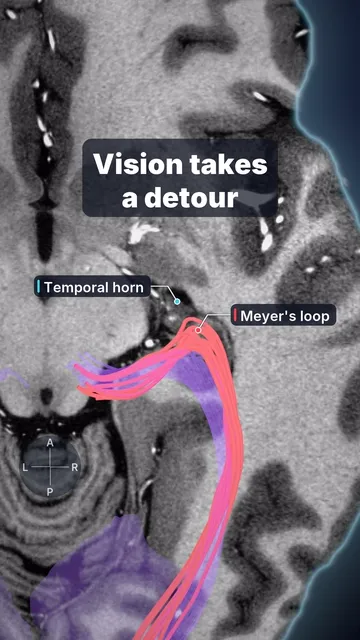
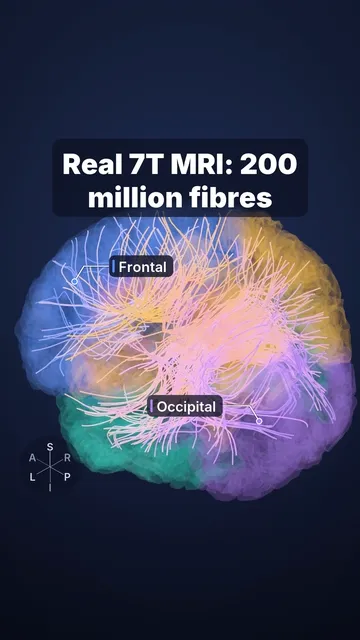
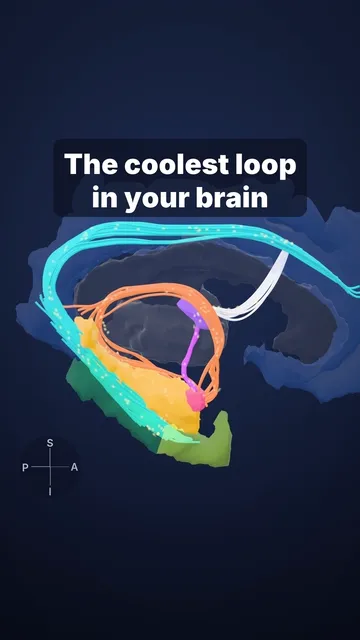
Rendered from open data: 7 T brain of a volunteer (Lüsebrink et al., Sci Data 2021, CC0); fibre tracts from the HCP1065 atlas (Yeh, Nat Commun 2022, CC BY-SA 4.0), data provided by the Human Connectome Project, WU-Minn Consortium (Principal Investigators: David Van Essen and Kamil Ugurbil; 1U54MH091657) funded by the 16 NIH Institutes and Centers that support the NIH Blueprint for Neuroscience Research; and by the McDonnell Center for Systems Neuroscience at Washington University. The crossing and the lesion are drawn schematically.
Video licence: CC BY-SA 4.0. To reuse it, credit “Cerebrarium (Aldo Spolaore)”, link to this page and name the data sources above.
Educational content, not medical advice.