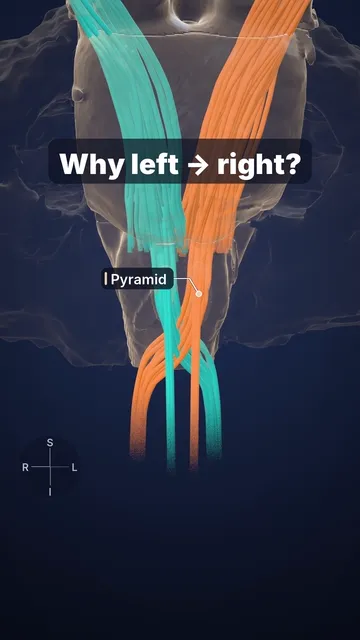
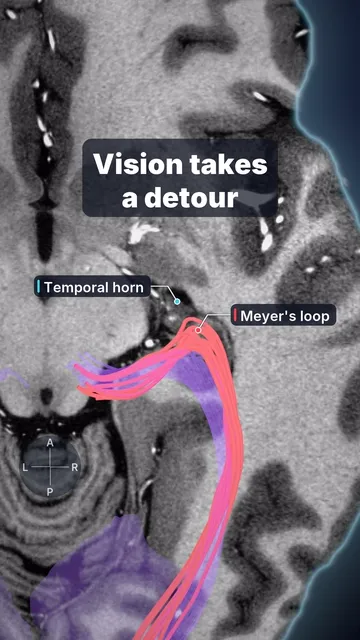
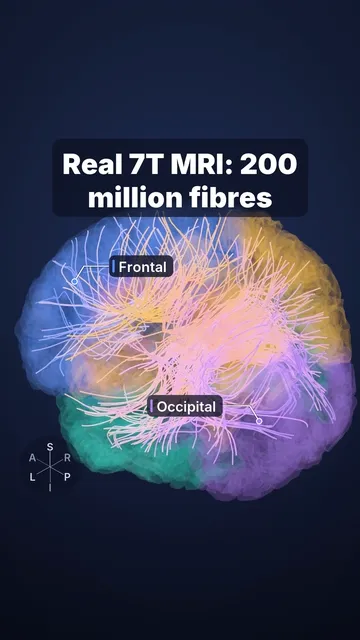
0:33, silent. Watch it with music on Instagram.
The Papez circuit in 3D
One loop in each hemisphere: from the hippocampus through the fornix, mammillary body, thalamus and cingulum, back to where it started.
There is one in each hemisphere. Follow it once around: hippocampus (subiculum) → fornix (up behind the thalamus, forward over it, down behind the anterior commissure) → mammillary body → mammillothalamic tract → anterior nuclei of the thalamus → thalamocingulate fibres (through the anterior limb of the internal capsule) → cingulate gyrus → cingulum (back over the corpus callosum, round the splenium) → parahippocampal gyrus → entorhinal cortex → perforant path → back to the hippocampus.
James Papez described it in 1937 as a circuit for emotion. Today it is seen as part of the extended hippocampal system for episodic memory: a set of parallel, mostly two-way connections, not a loop that memories circle around.
Clinical link: Wernicke-Korsakoff syndrome. A lack of vitamin B1 (thiamine), most often with heavy alcohol use or malnutrition, damages the mammillary bodies and the medial thalamus, including the anterior nuclei. New memories don't stick (anterograde amnesia), often with made-up stories filling the gaps (confabulation). Urgent thiamine treatment can prevent lasting damage.
Sources and licence
Rendered from open data: 7 T MRI and brain models of a volunteer (Lüsebrink et al., Sci Data 2021, CC0); mammillary bodies and mammillothalamic tracts from Neudorfer et al., Sci Data 2020 (CC BY 4.0); anterior thalamic nuclei from the Allen Human Reference Atlas 3D (CC BY 4.0); fornix and cingulum from the HCP1065 atlas (Yeh, Nat Commun 2022, CC BY-SA 4.0), data provided by the Human Connectome Project, WU-Minn Consortium (Principal Investigators: David Van Essen and Kamil Ugurbil; 1U54MH091657) funded by the 16 NIH Institutes and Centers that support the NIH Blueprint for Neuroscience Research; and by the McDonnell Center for Systems Neuroscience at Washington University. The thalamocingulate fibres and the perforant path are drawn schematically (no atlas tract).
Video licence: CC BY-SA 4.0. To reuse it, credit “Cerebrarium (Aldo Spolaore)”, link to this page and name the data sources above.
Educational content, not medical advice.