0:38, silent. Watch it with music on Instagram.
The emergency brake: the hyperdirect pathway
The hyperdirect pathway: the fastest route through the basal ganglia, and the reason the subthalamic nucleus is a target for deep brain stimulation.
The hyperdirect pathway, step by step:
- The motor cortex excites the STN directly (it skips the striatum).
- The STN excites the GPi.
- The GPi inhibits the thalamus more.
- The thalamus excites the motor cortex less → STOP.
Its fibres are branches of motor-cortex axons on their way down the internal capsule: a few millimetres above the STN a thin branch enters it, and the main axon goes on to the brainstem.
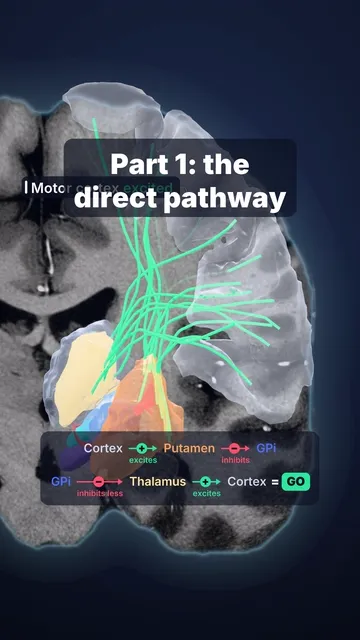
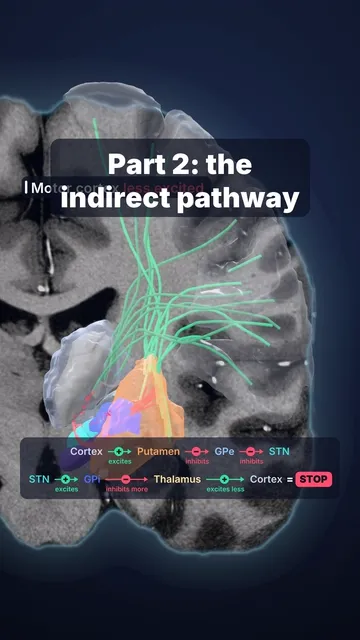
It is the fastest route. After a cortical signal the GPi is first excited through the hyperdirect pathway, then inhibited through the direct one, then excited again through the indirect one (Nambu, in monkeys). Think: stop everything, release the one movement you chose, stop the rest.
Clinical: in Parkinson's disease the STN overfires, and deep brain stimulation (DBS) of the STN is an established treatment. A lesion of one STN (for example a small stroke) causes wild flinging movements on the opposite side of the body: hemiballismus.
Sources and licence
Data: 7 T MRI of one volunteer (Lüsebrink et al., Sci Data 2021, CC0); pallidum split, STN: MASSP 2.0 (CC BY 4.0); VA/VL: Allen Human Reference Atlas 3D (CC BY 4.0); corticospinal, corticostriatal and thalamocortical fibres: HCP1065 tractography atlas (Yeh 2022, CC BY-SA 4.0). The hyperdirect branches, the STN → GPi and pallidothalamic fibres and the DBS lead are drawn by us (Coudé 2018; Petersen 2019; Gallay 2008). Green = excites, red = inhibits. Simplified textbook (rate) model.
Video licence: CC BY-SA 4.0. To reuse it, credit “Cerebrarium (Aldo Spolaore)”, link to this page and name the data sources above.
Educational content, not medical advice.