0:34, silent. Watch it with music on Instagram.
How your brain says GO: the direct pathway
The direct pathway, step by step: how the basal ganglia release the brake on movement.
At rest, the GPi (globus pallidus internus, together with the SNr) inhibits the motor thalamus (VA/VLa): a brake that is always on.
The direct pathway, step by step:
- The motor cortex excites the putamen (D1 neurons).
- The putamen inhibits the GPi.
- The GPi inhibits the thalamus less: the thalamus is released.
- The thalamus excites the motor cortex → the movement starts (GO).
Two inhibitions in a row = disinhibition.
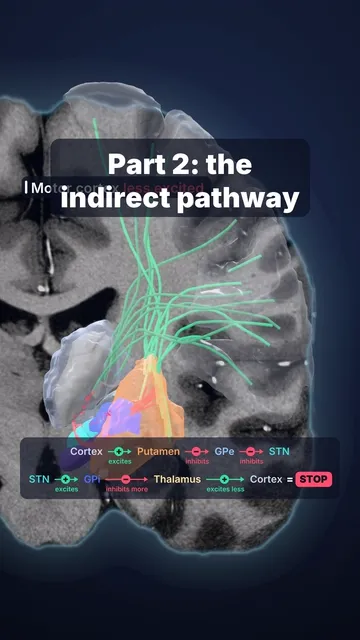
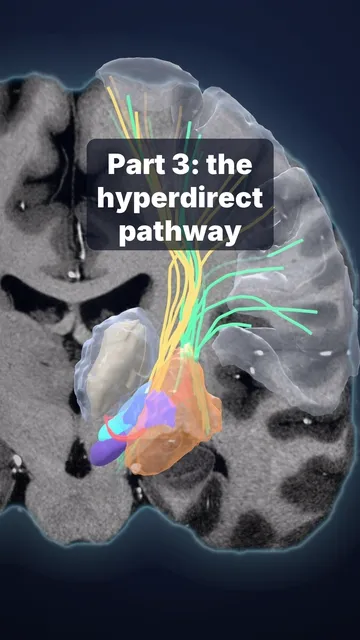
How the brake is wired: the GPi's fibres leave as the lenticular fasciculus, straight through the internal capsule, and as the ansa lenticularis, around it. Both meet in field H of Forel and turn up into the thalamus as the thalamic fasciculus (H1).
Dopamine from the substantia nigra (SNc) excites the direct pathway through D1 receptors. In Parkinson's disease these neurons are lost: GO gets weak, movements become slow and small (bradykinesia).
Sources and licence
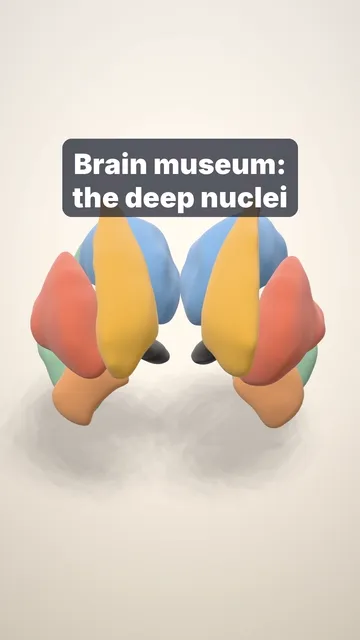
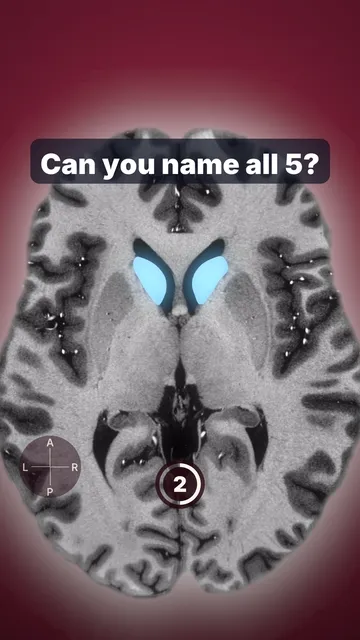
Data: 7 T MRI of one volunteer (Lüsebrink et al., Sci Data 2021, CC0); pallidum split, STN, substantia nigra: MASSP 2.0 (CC BY 4.0); VA/VL: Allen Human Reference Atlas 3D (CC BY 4.0); corticostriatal and thalamocortical fibres: HCP1065 tractography atlas (Yeh 2022, CC BY-SA 4.0). The pallidothalamic, striatopallidal and nigrostriatal fibres are drawn by us along published routes (Gallay 2008; Haber 2016). Green = excites, red = inhibits. Simplified textbook (rate) model.
Video licence: CC BY-SA 4.0. To reuse it, credit “Cerebrarium (Aldo Spolaore)”, link to this page and name the data sources above.
Educational content, not medical advice.