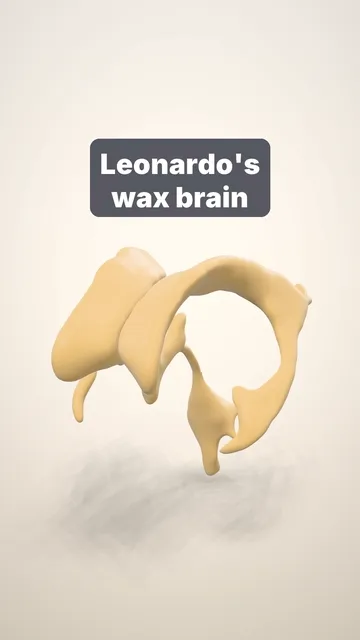
0:39, silent. Watch it with music on Instagram.
Name the 5 fluid spaces
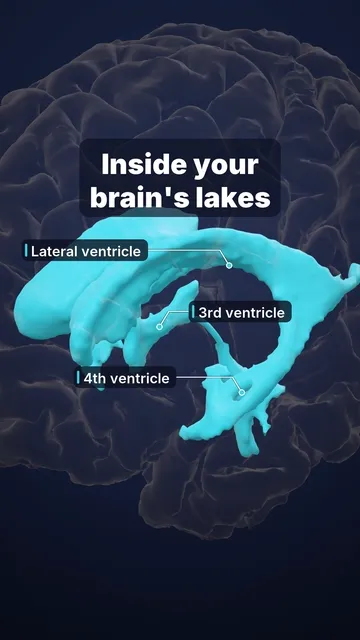
A quiz on the ventricles and the channels between them, traced from one 7 Tesla MRI.
Pause the video at each structure and name it before you open the answers.
Show the answers
- Lateral ventricles: you make roughly half a litre of CSF a day, but only ~150 mL is in your head and spine at any moment (~25 mL in the ventricles), so it is renewed about 3-4 times a day. The choroid plexus is the main source, not the only one.
- Third ventricle: a colloid cyst in its roof, right at the openings from the lateral ventricles (foramina of Monro), can rarely block CSF flow suddenly: acute hydrocephalus. Most are found by chance.
- Fourth ventricle: the lower end of its floor holds the area postrema, the chemoreceptor trigger zone for vomiting (a target in NMOSD: intractable hiccups, nausea or vomiting). CSF leaves the ventricles here, through two side openings (Luschka) and one in the midline (Magendie).
- Temporal horn: normally a barely visible slit, it widens early when CSF backs up. It also widens when the hippocampus shrinks (e.g. Alzheimer's), so a wide horn alone does not mean hydrocephalus.
- Cerebral aqueduct: ~15 mm long and 1-2 mm wide, the narrowest point of the system. Block it and the lateral and third ventricles swell while the fourth stays normal; aqueductal stenosis is the most common cause of congenital obstructive hydrocephalus.
Every structure in this video belongs to one person: traced from his 7 T MRI (0.25 mm voxels).
Sources and licence
Data: 7 T MRI of one volunteer (Lüsebrink et al., Sci Data 2021, CC0); ventricles segmented with FreeSurfer and smoothed for display, CSF channels traced by us. Facts: StatPearls (Physiology, Cerebral Spinal Fluid; Neuroanatomy, Cerebral Aqueduct); Radiopaedia (colloid cyst of the third ventricle; obstructive hydrocephalus; area postrema; aqueductal stenosis); Sakka et al. 2011; Missori et al., Tomography 2022.
Video licence: CC BY 4.0. To reuse it, credit “Cerebrarium (Aldo Spolaore)”, link to this page and name the data sources above.
Educational content, not medical advice.