0:33, silent. Watch it with music on Instagram.
Middle cerebral artery stroke: face, arm and speech
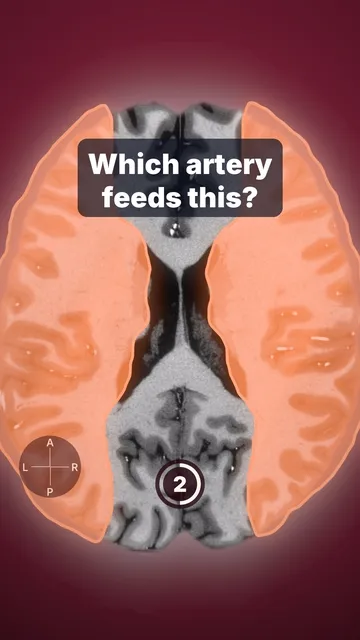
Middle cerebral artery (MCA) stroke: why face, arm AND speech go together
The MCA is the larger end branch of the internal carotid artery. It runs out sideways in the Sylvian fissure and feeds most of the side of the brain:
- the lower part of the motor strip: the face (lowest) and the arm + hand (just above),
- in the left hemisphere of most people, the language areas: Broca's area (speaking) and Wernicke's area (understanding),
- through its deep branches (lenticulostriate arteries), the basal ganglia and the internal capsule.
The leg area lies on the inner surface of the brain and is mostly fed by the anterior cerebral artery. That is why a stroke of the MCA's cortical branches usually hits the face and arm more than the leg. A clot in the first segment (M1) also cuts off the deep branches, and then the leg can be weak too.
Spot a stroke: FAST Face drooping · Arm weakness · Speech difficulty · Time to call 112 (EU) / 911 (US)
Every minute counts: in a typical large stroke, an estimated 1.9 million neurons are lost per minute without treatment (Saver, Stroke 2006). Clot-dissolving drugs and clot removal work best the earlier they start.
Sources and licence
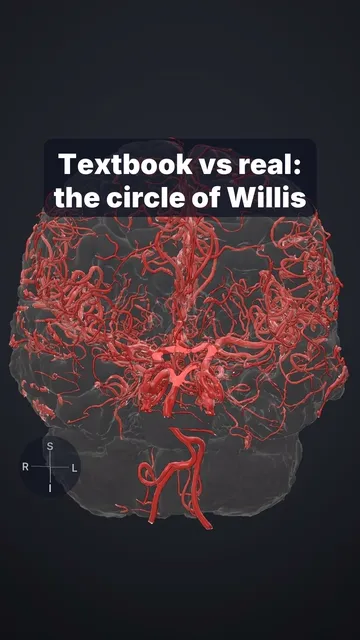
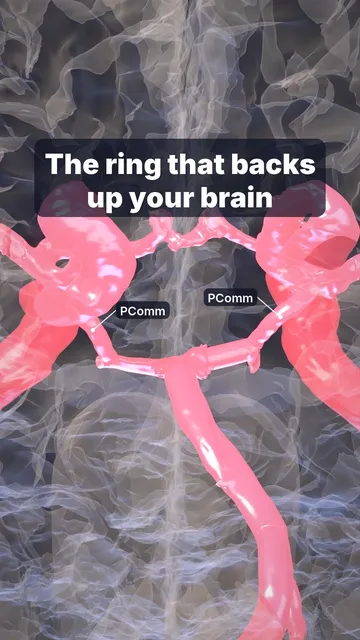
Data: 7 T MRI and TOF angiogram of one volunteer (Lüsebrink et al., Sci Data 2021, CC0); vessels segmented by us. Arterial territories: Liu et al., Digital 3D Brain MRI Arterial Territories Atlas, Sci Data 2023. Territory borders vary between people; the clot is drawn by us.
Video licence: CC BY-SA 4.0. To reuse it, credit “Cerebrarium (Aldo Spolaore)”, link to this page and name the data sources above.
Educational content, not medical advice.